
Case study
We understand the operational and marketing challenges specific to each sector.
Building a marketplace designed to scale
| Project type: | Custom marketplace platform |
| Client: | OLX Group |
| Industry: | Online marketplace |
| Role: | Architecture, backend & frontend development, business logic |
| Link: | https://marketplace.olx.ro |
| Project lead: | Liviu Jurubita, Founder & Lead Developer, Webstone Studio |
| Services: | Business-Driven Web Architecture, Custom Web Platforms, Integrations & Automation, Interface & Design Systems |
Overview
This project involved designing and building a large-scale marketplace platform used across multiple markets.
From the early stages, UX structure, UI design and technical architecture were developed together, ensuring that complex user flows, data models and performance constraints were addressed as a single system – not as separate layers.
The goal was not a typical website, but a robust, scalable platform capable of ingesting large datasets, exposing flexible search and filtering, and supporting long-term growth without accumulating technical debt.
UX & UI Design for a Data-Heavy Marketplace
The marketplace required complex user journeys, advanced filtering logic and scalable category structures.
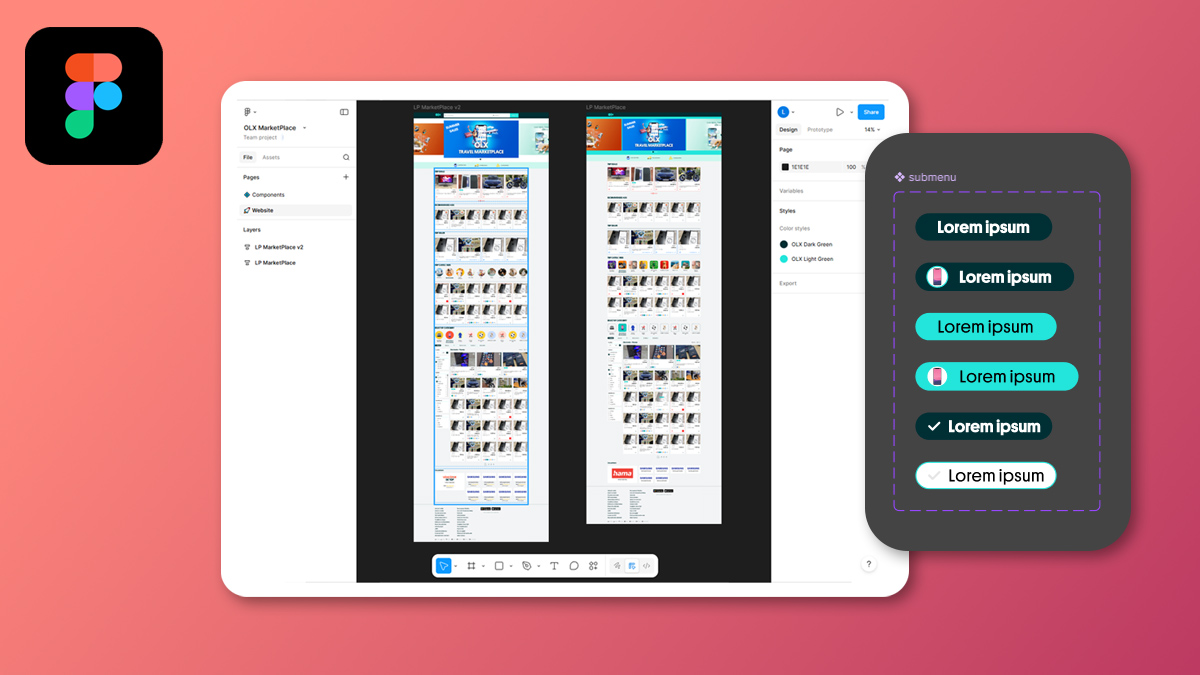
UX decisions were driven by real data constraints and technical feasibility, while the UI system was designed in Figma to support clarity, consistency and long-term evolution across multiple markets.
- UX strategy for complex browsing & filtering scenarios
- UI system designed in Figma, aligned with real data models
- Reusable components adapted for multi-market needs
- Close alignment between design decisions and platform logic
Context & Constraints
The platform operated in a high-content, data-driven environment, where thousands of items needed to be:
- imported from external sources
- normalized into a consistent data model
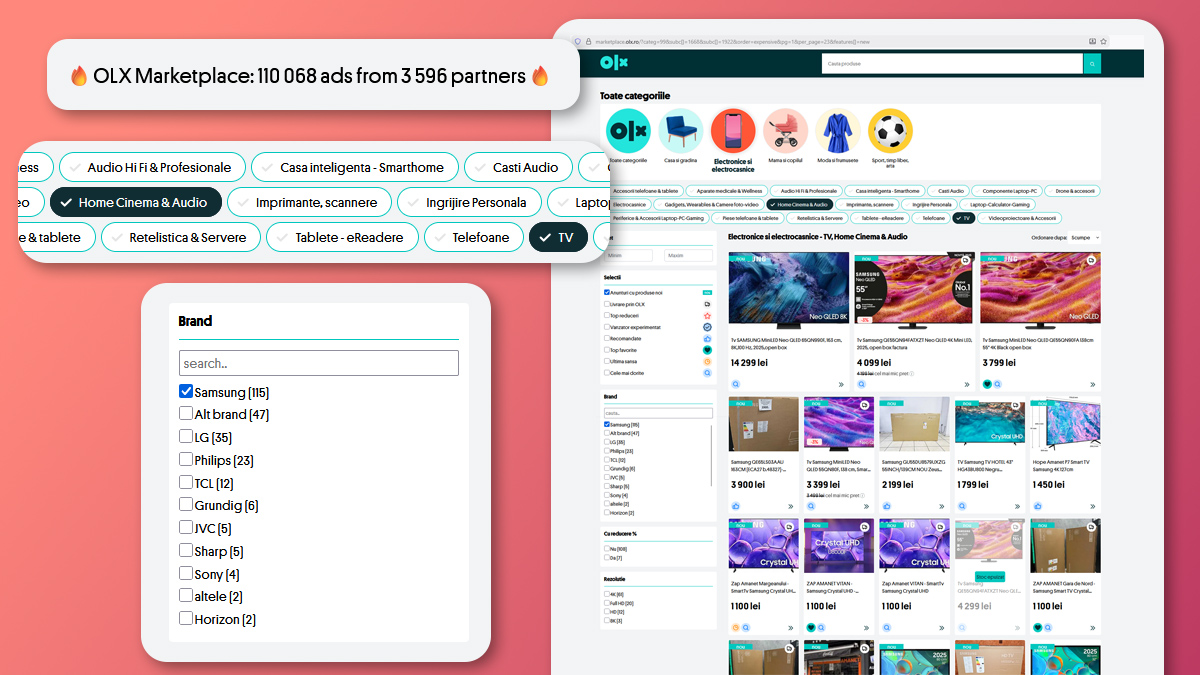
- exposed through dynamic, interdependent filters
- served with good performance under load
Key constraints included:
- Existing legacy structures that could not be replaced overnight
- Large datasets requiring efficient processing and querying
- Complex category-specific logic (filters, attributes, dependencies)
- The need for incremental evolution, not a full rewrite
- The solution had to be stable, extensible and safe to scale.
The Challenge
The main challenge was not visual design, but data and logic complexity.
Specifically:
- Managing multiple custom entities beyond standard CMS content
- Supporting dynamic filters that change based on category, context and user selections
- Handling large imports from external systems without performance degradation
- Avoiding fragile plugin-based solutions that would break at scale
Approach & Key Decisions
Instead of forcing the project into generic CMS patterns, the approach focused on explicit architecture and clear separation of concerns.
Key decisions included:
- Designing custom database structures tailored to marketplace needs
- Separating ingestion logic from public-facing queries
- Treating filters, attributes and values as first-class entities
- Building clear data pipelines instead of one-off scripts
Where possible, existing systems were respected, but reworked at the architectural level rather than patched.
Architecture & Implementation (High-Level)
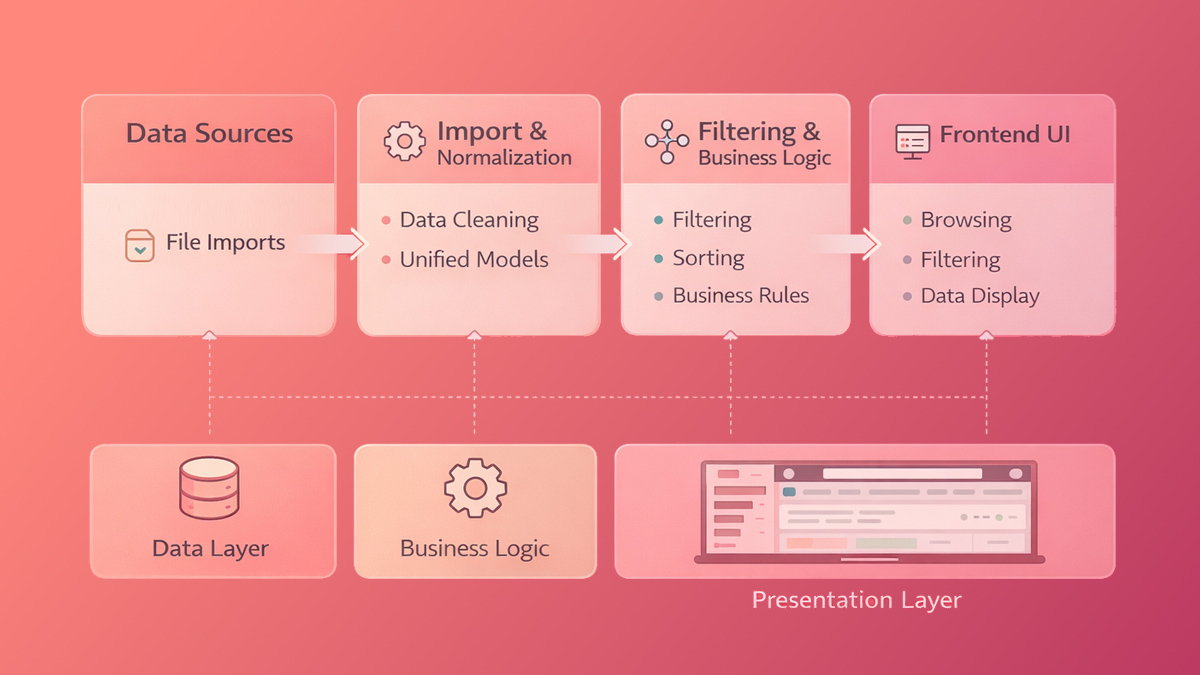
At a conceptual level, the platform was built around:
- Custom data models for listings, sellers, categories and attributes
- A controlled import
- Optimized querying for fast filtering
- A front-end layer consuming structured, predictable data
Rather than relying on heavy abstractions, the system favors:
- explicit logic
- readable queries
- predictable performance characteristics
This made it easier to debug, extend and reason about the platform over time.
Outcome & Impact
The final result was a stable marketplace foundation that:
- supports complex, category-specific filtering
- handles large volumes of listings reliably
- allows new attributes and logic to be added safely
- remains maintainable over time
Just as important, the platform became easier to evolve, reducing friction for future features and improvements.
What Made This Project Successful
Looking back, the most important factors were:
- Early focus on data structure and logic, not features
- Willingness to go beyond default CMS patterns
- Close collaboration with product and business stakeholders
- Treating the project as a long-term system, not a one-off build
This mindset helped avoid shortcuts that would have become problems later.
Collaboration Model
The work was done as a direct technical partnership, with hands-on involvement across:
- architecture decisions
- UI decisions
- backend and frontend development
- iteration and refinement as requirements evolved
There were no handoffs – decisions were discussed, evaluated and implemented with long-term impact in mind.
Final Note
This project is a good example of how custom logic, clear architecture and pragmatic decision-making can turn a complex marketplace into a stable, scalable platform.
If you are facing similar challenges – complex data, filtering logic, integrations or scale – the same approach applies.
If you're building something that needs to perform, scale and last, let's talk.
Start a project
 Liviu Jurubita